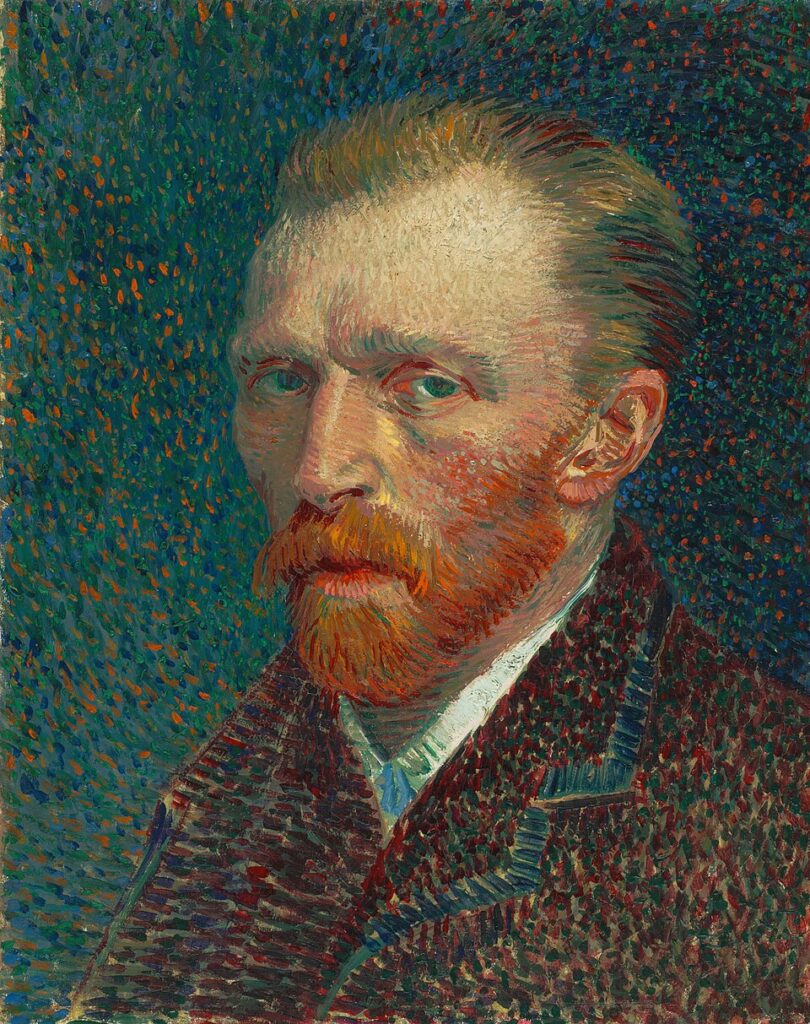
Vincent van Gogh taught himself to paint at 27 and was dead at 37. In the ten years between, he produced over 900 paintings and absorbed influences at a pace that bordered on compulsion. He wrote about art constantly — his surviving letters contain hundreds of references to other painters, including detailed analyses of technique, color theory, and personal feeling. He did not just admire certain artists; he copied them obsessively, studied their methods, and argued with their ideas in his own work. The people who shaped him were not random. Each one unlocked something specific.
Jean-François Millet: The Foundation
If there is one painter without whom Van Gogh as we know him probably does not exist, it is Jean-François Millet. Van Gogh called him “father Millet — counselor and mentor in everything for young artists.” That is not hyperbole from his letters; it reflects a real and sustained obsession that lasted his entire career.
Millet was a French painter of the Barbizon School, active from the 1840s to 1870s, who made peasants and agricultural laborers the dignified subjects of serious painting. Before Van Gogh could draw competently, he was already sketching after Millet’s compositions. The Sower — Millet’s image of a man broadcasting seed across a field — became one of Van Gogh’s most recurring references; he reinterpreted it multiple times across his career, each version reflecting where he was technically and emotionally at the time.
The connection was not purely aesthetic. Van Gogh had worked as a lay preacher among coal miners in the Belgian Borinage before he became a painter, and Millet’s moral seriousness about working people matched his own. Both men believed farmers and laborers were worthy of the same gravity that history painters reserved for mythological heroes. Van Gogh’s early masterpiece The Potato Eaters (1885) — dark, heavy, unflinching — is the most direct expression of this conviction, and it is Millet’s conviction as much as Van Gogh’s.
During his time at the asylum in Saint-Rémy in 1889–1890, Van Gogh made 21 painted copies of Millet’s works. He was working from black-and-white reproductions, not from color originals, which meant he was forced to invent the color himself. He described this process in a letter: “I put the black and white by or after Delacroix or Millet in front of me as a motif. And then I improvise in colour… seeking reminiscences of their paintings — but the memory, the vague consonance of colours which are at least correct in spirit, that is my interpretation.” The copies are not imitations. They are translations — Millet’s structure filled with Van Gogh’s color.
Rembrandt van Rijn: Light as Emotion
Van Gogh revered Rembrandt in the specific way one reveres someone who has already solved a problem you are trying to solve. The problem was how to make paint express psychological states — how light and shadow could carry feeling rather than simply illuminate form.
Rembrandt’s chiaroscuro — his system of extreme tonal contrast where figures emerge from deep shadow into concentrated light — influenced Van Gogh’s early Dutch period directly. The dark, heavily shadowed canvases of his Nuenen years (1883–1885) show this clearly. Van Gogh was drawn to how Rembrandt could render a face with a single area of warm light and surround it with near-darkness in a way that communicated interiority rather than just appearance.
In May 1890, while at Saint-Rémy, he made a painted copy after Rembrandt’s etching The Raising of Lazarus. The copy is not faithful to the original in any conventional sense — Van Gogh substituted the figure of Christ with a blazing sun, turning a resurrection scene into something elemental and personal. The respect for Rembrandt is in the bones of the composition. The interpretation is pure Van Gogh.
Eugène Delacroix: Color as a System
Delacroix gave Van Gogh permission to treat color as a language. The French Romantic painter had developed a systematic approach to complementary colors — the idea that placing colors opposite each other on the color wheel (red against green, blue against orange, yellow against violet) intensified both, making them vibrate against each other rather than simply sitting side by side. Van Gogh absorbed this completely.
In his letters to Theo, Van Gogh discusses color theory repeatedly and explicitly credits Delacroix as his primary source. He was particularly drawn to the idea that color could carry emotional weight independently of what was depicted — that a yellow sky could feel joyful not because skies are yellow but because of how the yellow is handled in relation to the surrounding colors. This is the theory behind The Night Café (1888), which Van Gogh described as an attempt to express “the terrible passions of humanity by means of red and green.” The color is doing work that the composition alone cannot.
Japanese Woodblock Prints: A New Way of Seeing
When Van Gogh arrived in Paris in 1886, he encountered Japanese woodblock prints — ukiyo-e — through the art dealer Siegfried Bing’s shop, whose attic he combed for prints. He and Theo eventually amassed a collection of over 600. The artists he studied most intensely were Utagawa Hiroshige and Katsushika Hokusai.
What the prints showed him was a completely different visual logic: flat planes of pure color with no gradation, bold outlines, asymmetrical compositions, unusual spatial angles, and an approach to nature that was attentive and joyful rather than monumental. He made direct painted copies of Hiroshige’s Plum Garden in Kameido and Sudden Shower over Shin-Ōhashi Bridge, adding decorative border text in Japanese characters that he could not read, as a kind of frame. The copies are not exercises — they are attempts to physically inhabit a different way of looking.
The influence fed into his palette. His Parisian and Arles-period canvases — Almond Blossom, the orchard series, Starry Night — have the flat areas of saturated color, the strong diagonal compositions, and the attention to natural detail that he learned from Japanese printmakers. One art historian has suggested that Hokusai’s The Great Wave — with its turbulent, curling water — may have influenced the swirling sky of Starry Night, painted the following year. Van Gogh himself wrote that he had learned to “see with a more Japanese eye,” and eventually felt he no longer needed the prints physically because the way of seeing had become his own.
Paul Gauguin: Memory Over Observation
Van Gogh’s relationship with Paul Gauguin was the most intense and destructive of his career, and it was also one of the most technically significant. The two men lived together for nine weeks in Arles in late 1888, the period that ended with Van Gogh cutting off part of his own ear. But before that breakdown, Gauguin taught him something important.
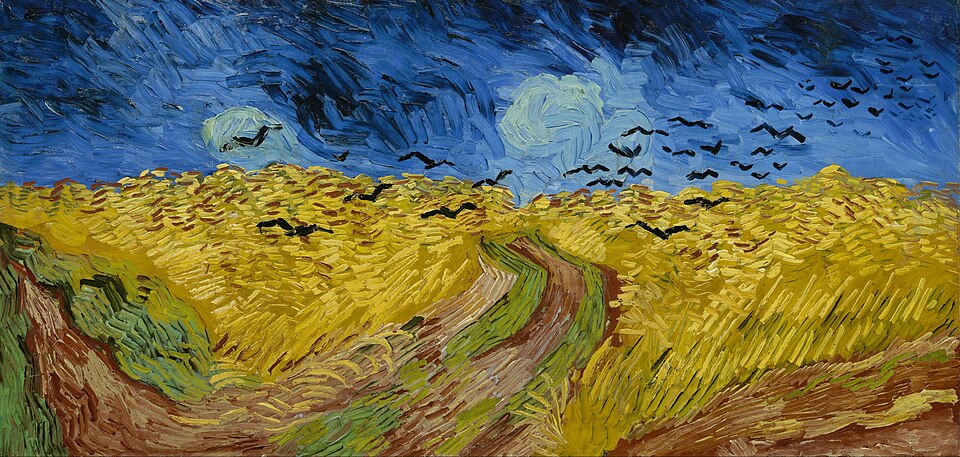
Gauguin painted from memory rather than from direct observation. He believed that working from imagination rather than from the motif in front of you produced work that was more emotionally true. Van Gogh was skeptical — his whole instinct was to paint what he could see — but he tried it, and the results changed his approach. After Gauguin’s arrival, Van Gogh’s work became more decorative, more boldly simplified, less tethered to the specific appearance of things. Even after Gauguin returned to Paris following their falling-out, his influence remained visible in Van Gogh’s painting for the rest of his life.
The Impressionists and Camille Pissarro: Lightening the Palette
Before Paris, Van Gogh’s palette was dark — browns, blacks, heavy shadows. The Dutch landscape tradition and Millet’s earthy tones had shaped his sense of color. In Paris, direct contact with the Impressionists — particularly through Camille Pissarro, who briefly mentored him — forced a transformation.
Pissarro encouraged Van Gogh to lighten his colors, to apply paint in shorter strokes, to engage with the scientific color theory that underpinned Pointillism. Van Gogh was also absorbing the work of Monet, Degas, and Seurat simultaneously. The result was a complete revision of his color sense between 1886 and 1888 — the most rapid and fundamental technical change of his career. The dark painter of The Potato Eaters and the luminous painter of Sunflowers are separated by less than three years.
Anton Mauve: The First Real Teacher
Before the major influences took hold, there was Anton Mauve — a respected painter of the Hague School and Van Gogh’s cousin by marriage, who gave him his first serious instruction in painting in 1881. Mauve taught him to work in watercolor and oil, introduced him to professional practice, and gave him a set of paints. The relationship broke down within months — Van Gogh’s stubbornness and Mauve’s more conventional approach were incompatible — but Mauve’s instruction gave him foundational technical grounding at the moment he needed it most.
The Pattern
What ties these influences together is that Van Gogh took from each of them something specific and needed. From Millet: moral seriousness about working people and the dignity of subject matter. From Rembrandt: the emotional power of light and shadow. From Delacroix: color as a systematic language of feeling. From Japanese printmakers: a new spatial logic and a lighter, flatter approach to color. From Gauguin: the freedom to work from memory and emotion rather than strict observation. From the Impressionists: the liberation of his palette.
None of these influences cancelled the others. Van Gogh was a synthesizer who took incompatible traditions — Dutch realism, French Romanticism, Japanese aesthetics, Impressionist color theory — and fused them under pressure of his own personality into something that did not exist before him. The influences are traceable. What he made from them is not.