Painting is the oldest deliberate human act we can still see. Not a metaphor — the literal oldest. Before agriculture, before writing, before cities, humans were mixing pigments and putting images on walls. Here is what the record actually shows, from cave floors to canvas.
It Started 100,000 Years Ago — Not 40,000
Most people cite cave paintings as the origin of painting and place them around 40,000 years ago. That figure refers to the oldest figurative European cave paintings, such as those in the Cave of El Castillo in Spain. But the actual origin of paint-making is far older. Archaeologists excavating Blombos Cave in South Africa found an ochre-based mixture dated at 100,000 years old, along with a complete stone toolkit used to grind pigment — shells acting as containers, grinding stones, and a mixing surface. Humans were making paint before Homo sapiens had even left Africa.
The oldest known cave painting as of recent dating is a handprint from Liang Metanduno on Muna Island in Indonesia, dated to at least 67,800 years ago. The Neanderthal-made handprint in Maltravieso Cave in Spain comes in just behind it. Painting, it turns out, was not exclusively a modern human invention.
The Pigments Were More Sophisticated Than People Assume
Early painters did not just smear dirt on walls. They developed a functional materials science. Black came from charcoal and manganese dioxide. Red and yellow were iron oxides — hematite and limonite respectively. White was derived from gypsum, chalk, or calcite. These pigments were mixed with binders: animal fat, water, plant juices, saliva. The painters at Lascaux Cave in France, working between 17,000 and 19,000 years ago, showed a demonstrable understanding of perspective, shading, and color layering.
By 3000 BC, the Egyptians had developed synthetic pigments. They mixed sand, lime, and copper ore, then heated the mixture to produce Egyptian Blue — one of the earliest manufactured colors in history. Egyptian tomb painters worked with a standardized six-color palette: charcoal black, red ochre, yellow orpiment, brown ochre, blue azurite, and green malachite. King Tutankhamun was buried with a paint box containing powdered malachite, orpiment, and red ochre.
The Greeks, around 400–300 BC, invented lead white by sealing strips of lead in earthenware pots with vinegar and covering them with manure. The resulting corrosion produced a brilliant white pigment that became the dominant white paint in Western art for over 2,000 years — used by Rembrandt, Vermeer, and Picasso. It was also slow poisoning for anyone who worked with it extensively.
The Mona Lisa Is Not Who You Think
The world’s most famous painting carries a name that is itself a misidentification. “Mona Lisa” is a contraction of “Madonna Lisa,” an honorific title. Research by top universities suggests the subject was Lisa Gherardini, wife of a Florentine silk merchant named Francesco del Giocondo — which is why the painting is also called “La Gioconda” in Italian and “La Joconde” in French.
Leonardo did not use standard paint. Scientists analyzing a microscopic paint sample from a corner of the work detected a rare compound called plumbonacrite, formed from lead oxide. This indicates that Leonardo mixed lead oxide powder into his paint to thicken it and accelerate drying. The same compound turned up in samples from The Last Supper, suggesting this was a deliberate technique Leonardo developed across his major works, not an anomaly.
The painting’s much-discussed eyebrows are missing because Leonardo, a perfectionist, never finished the portrait. He kept it, refined it, and carried it with him until his death.
The Last Supper Is Barely There Anymore
Leonardo da Vinci’s The Last Supper, painted between 1495 and 1498, is one of the most reproduced religious images in history. It is also one of the most deteriorated. Leonardo experimented with a mixed-media technique on dry plaster rather than the traditional fresco method of painting on wet plaster. The result was that the paint began flaking off within decades of completion. By the 1600s it was already described as a ruin. The version tourists see today in Milan is largely the result of multiple restorations over several centuries — very little of Leonardo’s original surface survives.
Van Gogh Painted The Starry Night From Imagination
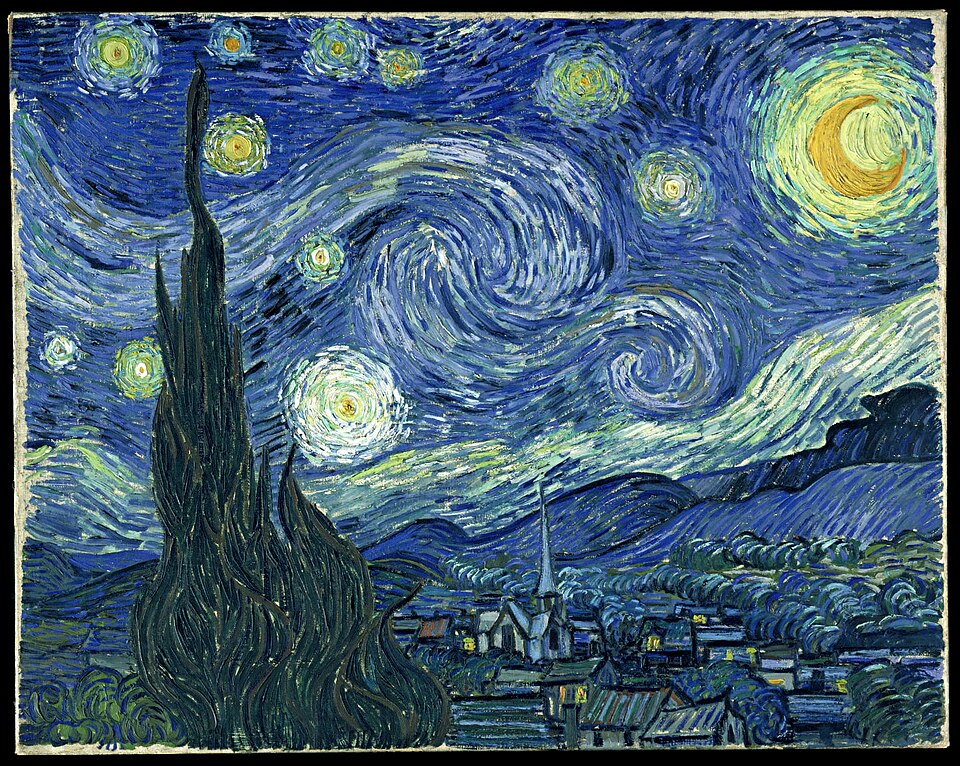
When Van Gogh was committed to the Saint-Paul-de-Mausole asylum in Saint-Rémy-de-Provence in 1889, he was restricted to the hospital grounds. The Starry Night was painted there. The quiet village shown in the painting’s foreground was not visible from his window — it was largely invented from memory and imagination. The church steeple resembles churches from his native Netherlands, not the region of Provence.
The churning sky, long interpreted as purely emotional, caught the attention of physicists decades later. Scientists noted that the painting’s turbulent whorls correspond to mathematical patterns found in fluid turbulence — a natural phenomenon that was not formally described until the 20th century. Whether Van Gogh perceived this intuitively or simply captured something his eye registered without his mind categorizing it remains an open question.
Vermeer Almost Certainly Used an Optical Projection Device
Johannes Vermeer, the 17th-century Dutch master, produced paintings of extraordinary photographic precision. Art historians have long debated how. The leading theory is that Vermeer used a camera obscura — a device that projects a scene onto a surface in a darkened room through a pinhole or lens. Evidence includes the fact that Vermeer showed no preliminary pencil outlines in his paintings (unusual for the period), yet achieved near-perfect perspective across complex domestic interiors.
More telling are the globular dots of impasto called pointillés scattered across objects in his paintings — bright, haloed highlights that do not correspond to what the naked eye sees, but do correspond precisely to optical distortions produced by the imperfect lenses of a camera obscura. Researchers examining paintings like The Lacemaker and Girl with a Red Hat found that these optical artifacts are applied even to non-reflective surfaces, suggesting Vermeer imported the visual vocabulary of the device into his painting style. Whether he traced directly from projections or simply studied their optical effects and painted from memory of them, the camera obscura was almost certainly in his studio.
Monet Painted His Greatest Work Partially Blind
By the time Claude Monet began his monumental Water Lilies series, cataracts had severely degraded his vision. Critics at the time attacked the later paintings as formless and overly abstract — an embarrassment for a master painter, they suggested. Monet rejected the criticism and kept painting. His failing eyesight produced color shifts and softened edges that critics dismissed as error and that later generations recognized as innovation. The Water Lilies series is now considered the bridge between 19th-century Impressionism and 20th-century abstract expressionism.
Jackson Pollock’s Drip Technique Was Not His Invention
The drip technique Pollock made famous was developed earlier by Janet Sobel, a Ukrainian-American artist who discovered painting in an unusual way: her son criticized her opinion of his artwork and handed her a brush to do better. She discovered an instinctive talent for abstract expressionism and pioneered the drip method before Pollock came to prominence. Pollock saw her work and the influence on his later technique is documented.
The Olympics Gave Out Medals for Painting
From 1912 to 1948, the Olympic Games included competitions in the arts. Painters, sculptors, architects, and writers competed for medals alongside athletes. The founder of the modern Olympics, Pierre de Coubertin, believed athletic excellence and artistic achievement were inseparable, and designed the original modern Games to test both. The art competitions were eventually discontinued because the International Olympic Committee ruled that professional artists — unlike amateur athletes — were ineligible.
The Record Has Gaps, But Not Where You Think
The common assumption is that most of art history was lost to time. In some ways the opposite is true. The chemistry of ancient pigments can still be traced under a microscope. Mineral impurities in ground pigments reveal where the ochre was mined and how far it traveled — including a documented 25-mile journey by Lascaux cave painters from their ochre source. The paintings survived. The names of the painters did not. Across most of human history, the art outlasted the artist by tens of thousands of years.
That ratio has not changed much.