Painting style and painting subject are two different things — a fact worth establishing upfront. Subject is what is painted: a landscape, a portrait, a still life. Style is how it is painted: the visual language, the approach to color and form, the philosophical stance behind the brushwork. The same bowl of fruit can be painted in a dozen different styles and produce a dozen completely different experiences for the viewer.
There are over 75 recognized painting styles in art history. What follows covers the most significant — the ones that defined eras, broke movements, and still shape how artists work today.
A Quick Reference: Painting Styles at a Glance
| Style | Period | Defining Characteristic | Key Artists |
|---|---|---|---|
| Realism | 1840s–1880s | Accurate depiction of ordinary life, no idealization | Gustave Courbet, Jean-François Millet |
| Impressionism | 1860s–1880s | Loose brushwork, light over form, painted outdoors | Monet, Renoir, Degas, Manet |
| Post-Impressionism | 1880s–1900s | Personal expression, color and structure pushed further | Van Gogh, Cézanne, Gauguin, Seurat |
| Pointillism | 1880s–1890s | Tiny unmixed dots of color that blend optically | Georges Seurat, Paul Signac |
| Fauvism | 1905–1910 | Raw unnatural color, paint straight from the tube | Matisse, Derain, Vlaminck |
| Expressionism | 1905–1930s | Distorted form and color to convey inner emotion | Edvard Munch, Ernst Ludwig Kirchner |
| Cubism | 1907–1920s | Multiple perspectives simultaneously, geometric fragmentation | Picasso, Braque, Juan Gris |
| Surrealism | 1920s–1940s | Dream imagery, unconscious mind, psychological dislocation | Dalí, Magritte, Max Ernst |
| Abstract Expressionism | 1940s–1950s | Gestural, large-scale, emotionally driven abstraction | Pollock, de Kooning, Rothko |
| Pop Art | 1950s–1960s | Commercial imagery, mass culture, flat bold color | Warhol, Lichtenstein, Keith Haring |
| Minimalism | 1960s–1970s | Stripped-down form, no narrative, pure visual experience | Frank Stella, Ellsworth Kelly |
| Photorealism / Hyperrealism | 1960s–present | Photographic or beyond-photographic accuracy | Chuck Close, Ralph Goings |
| Street Art / Urban Art | 1970s–present | Public surfaces, political commentary, accessible imagery | Banksy, Jean-Michel Basquiat |
The Styles in Detail
Realism
Realism arrived in mid-19th century France as a deliberate rejection of Romanticism’s idealized drama and Neoclassicism’s elevated historical subject matter. Realist painters painted what they actually saw: peasants working fields, factory workers, ordinary people in ordinary settings, without beautifying or elevating them. Gustave Courbet’s stone-breakers and Jean-François Millet’s agricultural laborers were painted with the same seriousness that Academic painters reserved for gods and emperors.
Realism is the baseline from which most subsequent Western painting styles either continue or consciously break. It established that any subject is worthy of serious artistic attention. The visual hallmark is smooth, careful brushwork that conceals itself — you see the scene, not the paint.
Impressionism
Impressionism is probably the most recognizable painting style in the world and the most misunderstood. It is not a style of soft, pleasant scenes. It is a specific technical and philosophical position: that what matters in a painting is the impression of a moment — the specific quality of light at a particular time of day — rather than the accurate rendering of permanent form.
Impressionists preferred to paint outdoors to capture their subjects in various lighting conditions, and because they were capturing fleeting moments like sunrises and sunsets, they had to work quickly. The main characteristics are quick, gestural brushstrokes and wet-on-wet painting techniques. Form is suggested, not defined. Shadows have color. The paint is visible as paint. Claude Monet’s Water Lilies series is the extreme expression of this: by the late series, the surface of water and the reflections in it have become almost indistinguishable — pure light and color.
Post-Impressionism
Post-Impressionism is not a single coherent style but a collective term for what happened when painters took Impressionism’s loosened rules and pushed them in their own directions. The movement encompassed a variety of styles and approaches, from Van Gogh’s expressive brushwork to Paul Cézanne’s structural analysis of form.
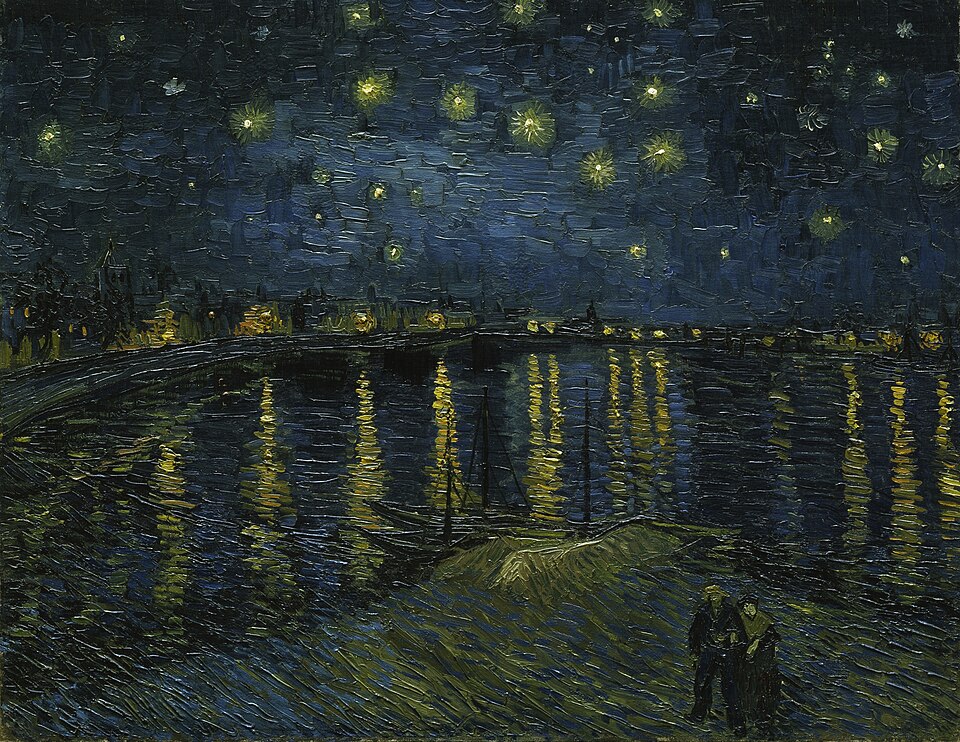
Van Gogh used color and brushstroke as direct emotional expression — the swirling sky of The Starry Night is not what the sky looks like, it is what the sky feels like to a person in psychological distress. Cézanne was doing something more analytical: reducing everything to its underlying geometric structure — the cylinder, the sphere, the cone — which fed directly into Cubism. Gauguin fled to Tahiti and used flat, symbolic color with no interest in perspective. Three artists, three completely different outcomes from the same starting point.
Pointillism
Pointillism is a specific technique developed by Georges Seurat in the 1880s based on scientific color theory. Pointillist artists placed small dots of unmixed color side by side, believing that using dots of unmixed pigments would allow for greater luminosity and vibrant color — the dots blend not on the canvas but in the viewer’s eye. Seurat’s A Sunday Afternoon on the Island of La Grande Jatte took two years to complete and consists of millions of carefully placed dots. The effect is luminous but static — the method makes spontaneity impossible.
Fauvism
Fauvism lasted approximately five years (1905–1910) and produced some of the most visually loud paintings ever made. The name was given by a critic who called their work “wild beasts.” Fauvism focused on pure color — paint was applied straight from the tube with great force, and traditional color choices were abandoned entirely. Skies were red, trees were purple. Henri Matisse was its leading figure. Fauvism had no interest in representing the world accurately. Color was an end in itself, not a tool for describing surfaces. It was brief but detonating — it influenced Expressionism, Abstract Expressionism, and Color Field painting.
Expressionism
Expressionism is distinguished by the hyperbolical flow of human emotions, distortion and exaggerated portrayal of places, people and objects, vague forms and shapes. Unlike Fauvism, it was less focused on color and more focused on conveying psychological states. Edvard Munch’s The Scream (1893) is the defining example: the figure, the landscape, the sky are all distorted by the same psychological pressure, as if the external world is being filtered through a mind in crisis. German Expressionism of the early 20th century extended this into urban alienation, social critique, and — eventually — the experience of two world wars.
Cubism
Cubism, launched by Pablo Picasso and Georges Braque around 1907 and significantly influenced by Cézanne’s late work, did something that had never been done before in painting: it showed an object from multiple viewpoints simultaneously. A face shown from the front and in profile at the same time. A guitar broken into its planes and reassembled at different angles. Cubist fragmentation went on to birth Futurism, Constructivism, and geometric abstraction — it was the technical seed of virtually all 20th-century abstract painting.
Surrealism
Surrealism grew from theories of psychology from Sigmund Freud and ideas from André Breton. Key artists were Salvador Dalí, René Magritte, and Max Ernst. Ideas came from dreams and automatic techniques designed to bypass conscious control, and the style used distorted shapes, figures, and perspectives to create unique works — trains emerging from fireplaces, melting clocks, faces replaced by apples. Dalí’s technique was hyperrealistic — everything rendered with photographic precision, but combined into combinations that could only exist in dreams. Magritte was cooler and more conceptual. Both used technical realism to paint impossible situations, which is the central Surrealist paradox.
Abstract Expressionism
Abstract Expressionism emerged in New York in the 1940s and 1950s, the first American art movement to gain significant international influence. It was a post-war movement emphasizing gestural freedom and emotional expression through large-scale abstract art. Jackson Pollock dripped and poured paint directly onto canvases laid on the floor. Mark Rothko reduced painting to fields of luminous color with no form at all — the experience was meant to be meditative, almost spiritual. Willem de Kooning retained gestural figuration but dissolved the figure into the brushwork. The common thread is that the painting process itself — the physical act — is part of the meaning.
Pop Art
Pop Art brought commercial imagery, mass production, and celebrity culture into fine art. Bold colors, flat brushwork, primary color contrasts, and dark outlines gave the work a comic-book effect. Repetition and repeated motifs — Andy Warhol’s soup cans, his repeated celebrity portraits — were central to the style. Pop Art was a direct response to Abstract Expressionism’s seriousness and interiority. Where Abstract Expressionism turned inward, Pop Art turned outward toward advertising, television, and consumer culture. Roy Lichtenstein reproduced comic-book panels at monumental scale. It was both a celebration of popular culture and an implicit critique of it.
Minimalism
Minimalism in painting strips everything away. The style focuses solely on what is in front of the audience and makes no attempt to reflect an external world. Frank Stella’s shaped canvases, Ellsworth Kelly’s flat color fields — there is no narrative, no symbolism, no reference beyond the painting itself. Color, line, and form are the only subjects. The viewer is asked to experience the painting as an object, not as a window into something else.
Photorealism and Hyperrealism
Photorealism emerged in the 1960s as painters began reproducing photographs with oil paint at such fidelity that the two became almost indistinguishable. Hyperrealism is an advancement of photorealism where painting and sculpture are executed in a manner to provoke a superior emotional response and to arrive at higher levels of realism than photography itself achieves. All works must start from a photographic reference point. Chuck Close worked from photographs of faces, reproducing skin, pores, and reflections in the eye with absolute precision. The effect is simultaneously familiar and deeply strange — the human face magnified to the point where it becomes abstract.
Street Art
Street art developed out of graffiti culture in New York and Philadelphia in the early 1970s and expanded globally through the 1980s and beyond. It is the only major painting style whose primary medium is public space. Jean-Michel Basquiat moved from street tags to gallery paintings and was one of the few artists to successfully bridge both worlds. Street artists frequently reinterpret Pop Art’s visual vocabulary — bold graphics, text, recognizable imagery — applied to walls, trains, and public surfaces rather than canvas. Banksy uses stencil-based work to deliver political and social commentary in the most visible possible locations. The style has no single look; what it shares is context.
How to Read a Painting Style
When you stand in front of an unfamiliar painting and want to identify the style, four questions do most of the work:
- Is the brushwork visible? Smooth and hidden = Realism or Academic painting. Visible and gestural = Impressionism, Expressionism, or Abstract Expressionism.
- Is the color natural? Naturalistic = Realism, Impressionism. Arbitrary or extreme = Fauvism, Expressionism, Surrealism.
- Is the subject recognizable? Recognizable = most styles through Surrealism. Partially fragmented = Cubism. Entirely non-representational = Abstraction, Minimalism.
- What does it make you feel, and does that seem intentional? Calm, contemplative = Realism, Minimalism. Urgency, discomfort = Expressionism, Baroque. Confused, dreamlike = Surrealism, Dada.
No single style owns beauty. Different styles ask different questions of the viewer — and the history of painting is largely the history of those questions changing.