Van Gogh signed his paintings with one word: Vincent. Not Van Gogh, not V.V.G., not his initials — just his first name. For a 19th-century painter, this was unusual enough to warrant explanation, and Van Gogh gave one himself.
Why Only “Vincent”
There were two reasons, both documented in his own letters.
The first was practical. Van Gogh spent most of his working life outside the Netherlands — in England, Belgium, and France — and knew from experience that non-Dutch speakers consistently mangled his surname. “Van Gogh” in Dutch is pronounced roughly van Khokh, with a guttural fricative that French and English speakers find difficult and often render as “Van Go” or “Van Goff.” In a letter to Theo in March 1888, written while some of his paintings were being shown in an exhibition in Paris, he was explicit: “My name must be put in the catalogue the way I sign it on the canvases, i.e. Vincent and not Vangogh, for the excellent reason that people here wouldn’t be able to pronounce that name.”
The second reason was personal. Van Gogh’s relationship with his father Theodorus was difficult and deteriorating, and with most of the wider family strained. Using only his first name was a way of separating himself from the Van Gogh name as a family identity while still claiming his own identity as an artist. He remained close to Theo, but the surname carried weight he did not want attached to his work.
He was not the first painter to use only a first name — Rembrandt, whom Van Gogh deeply admired, signed his work “Rembrandt” rather than the full Rembrandt Harmenszoon van Rijn. The precedent mattered to him.
How Many Paintings He Actually Signed
This is where the numbers get surprising. Van Gogh created around 1,000 paintings, of which 840 survive. Of those 840, only 133 carry a signature — just 16%. For a 19th-century artist, that is an unusually low proportion. Gauguin, his contemporary, signed around 60% of his output. Van Gogh’s low signing rate reflects several things: the speed at which he worked (sometimes multiple paintings in a single day), his view of many canvases as studies or experiments rather than finished works, and the fact that he never expected most of his paintings to circulate publicly during his lifetime. He wasn’t signing for the market. He was painting for himself and for Theo.
Where He Put the Signature and In What Color
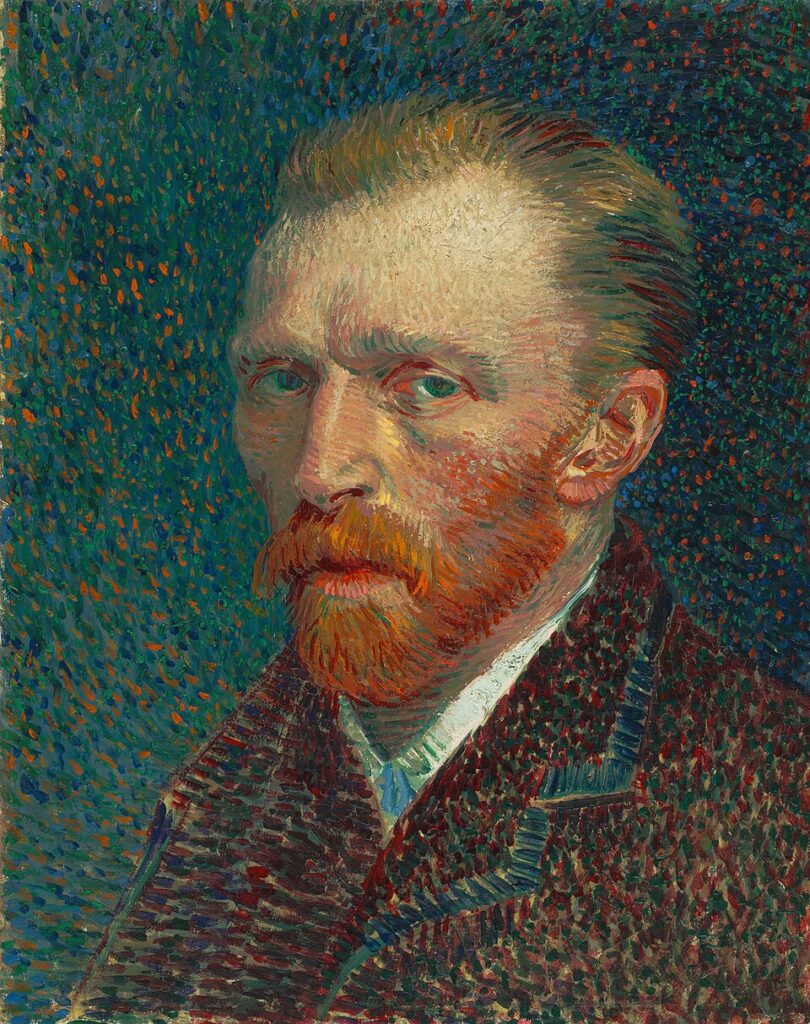
Van Gogh most commonly signed on the lower left of the canvas, though he was inconsistent about this. He sometimes placed the signature on the lower right, and occasionally embedded it within the painting itself — on an object depicted in the scene. In his Self-Portrait as a Painter, the signature appears on the stretcher of a painting shown within the painting. In Sunflowers, it is inscribed on the vase.
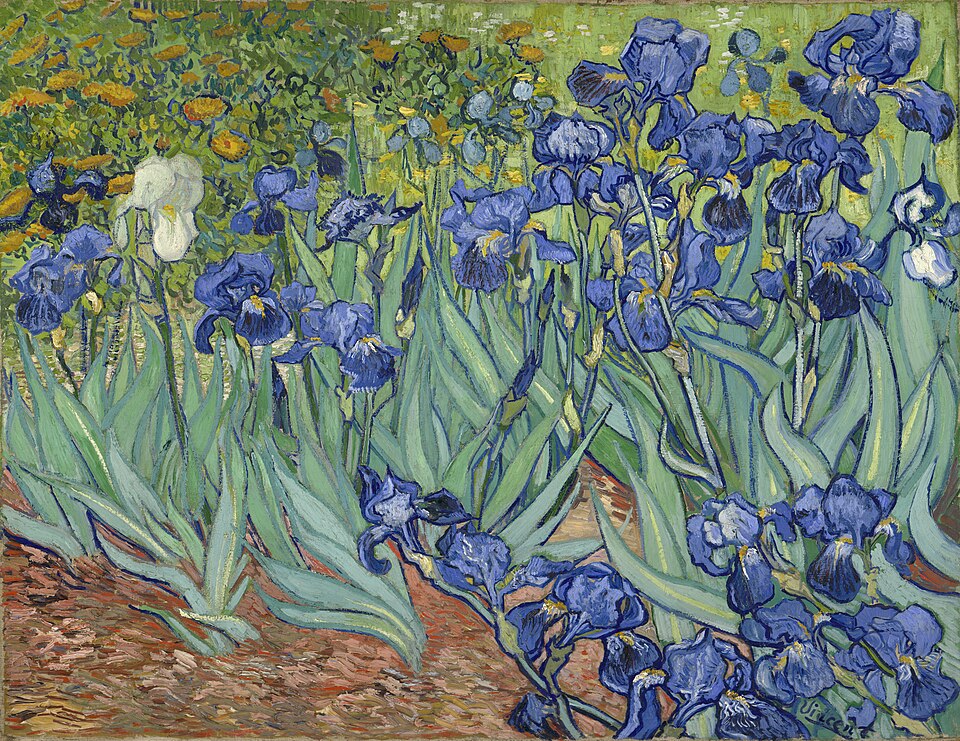
The color he used for signatures is one of the more unexpected details: red, used on more than half of his signed works — 75 out of 133. Red signatures were uncommon among 19th-century painters, for whom black or dark brown was standard. Van Gogh used it deliberately, treating the signature itself as a compositional element rather than a neutral administrative mark. He often emphasized the first stroke of the V more heavily than the other letters, giving the signature a characteristic weight on that opening downstroke.
He sometimes added a date, using only the last two digits of the year. Occasionally he added a dedication — Basket of Apples (1887) was inscribed “to my friend Lucien Pissarro.”
What This Means for Authentication
A painting signed “V. van Gogh” or “Van Gogh” should immediately raise questions — authentic signed works almost universally use “Vincent” alone. But a missing signature proves nothing either way. The majority of genuine Van Gogh paintings are unsigned, and attribution of unsigned works relies on provenance records, references in his letters to Theo, stylistic analysis, and technical examination of materials. Van Gogh is among the most forged artists in history, and the combination of a distinctive but simple signature with a large body of unsigned work has given forgers significant room to operate across the 20th and 21st centuries.
The signature, when it appears, is a small red word in the lower left corner. Quiet, first-name only, slightly emphatic on the V. It looks like something a person signed for themselves, not for posterity — which is exactly what it was.