Vincent van Gogh did not arrive in a vacuum. His family was deeply rooted in Dutch religious life, art dealing, and public service across multiple generations — and the peculiar tragedy of the family did not end with him. His brother died six months after he did. The name Vincent passed down through every generation like a responsibility no one quite knew how to put down. What follows is the documented genealogy, from his grandparents to the living descendants who still carry the name.
The Name “Van Gogh” and Where It Comes From
The surname van Gogh is believed to derive from a small town called Gogh on the German-Dutch frontier. The family had been established in Holland since at least the 16th century — an early genealogical record cited by Vincent’s sister-in-law Johanna traces the line to a Jacob van Gogh of Utrecht, whose son Jan sold wine and books. The lineage had recurring connections to art, literature, and the church across several generations before the painter was born.
Generation One: The Grandparents
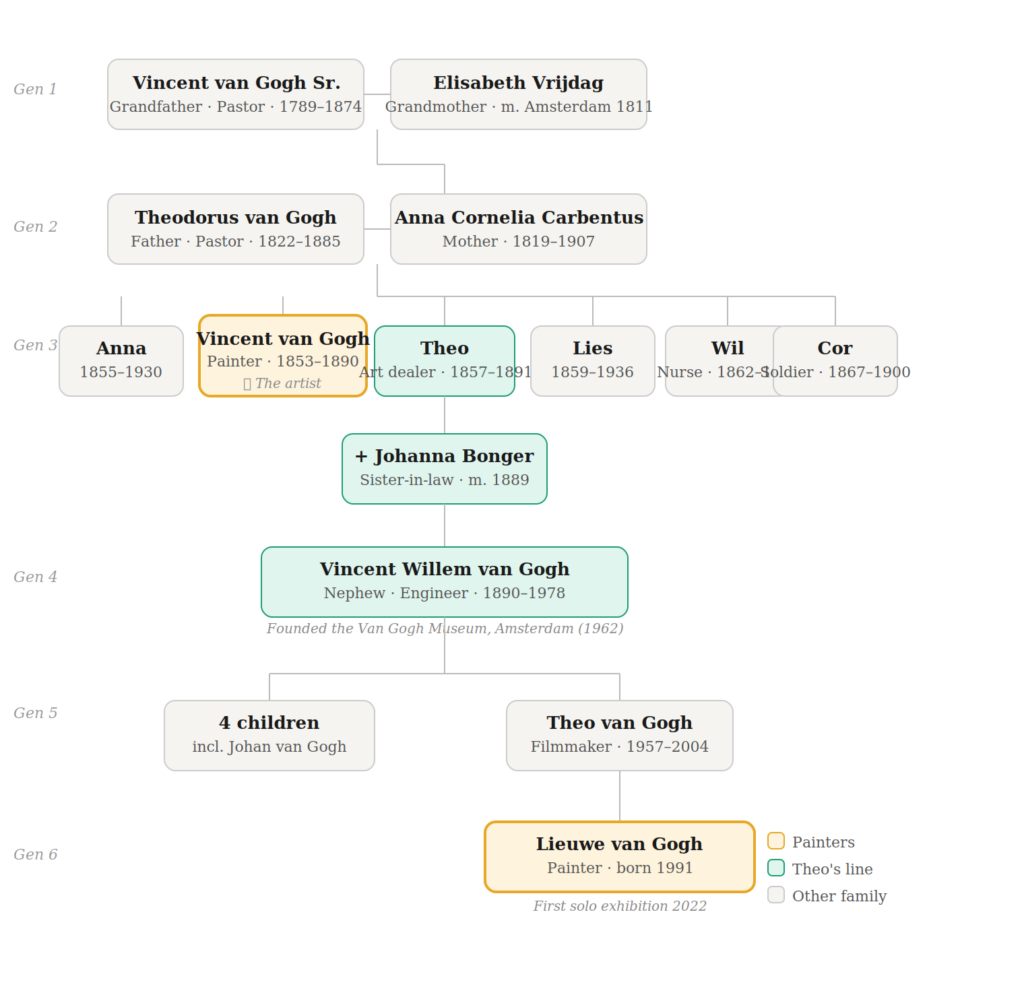
Vincent van Gogh (1789–1874) — the painter’s paternal grandfather — was a pastor and the son of Johannes van Gogh and Johanna van der Ven. He had eleven children, six of whom were sons. One of those sons was also named Vincent. The name had already been in use in the family for at least two generations before the painter was born.
Elisabeth Huberta Vrijdag married Vincent van Gogh the elder in Amsterdam in 1811. Together they had eight children.
Generation Two: The Parents
Theodorus van Gogh (1822–1885) — known to the family as Dorus — was the painter’s father and one of six brothers in his generation. He was the only one of the six to follow his father into the ministry, becoming a pastor of the Dutch Reformed Church, which adhered to Calvinist doctrine. He was described by his daughter-in-law Johanna as a handsome man with an amiable character. He secured a position as pastor in Groot-Zundert, a small village in the North Brabant region of the Netherlands, and it was there that all six of his children were born. He died suddenly in March 1885. Vincent painted his father’s Dutch Bible — Still Life with Bible — in the months following that death.
Anna Cornelia Carbentus (1819–1907) was the painter’s mother. Her father was in the book trade. She married Theodorus in May 1851 and outlived him by 22 years, dying in 1907 at 87. Vincent copied her sketches as a child — some of his earliest exposure to making images came from watching her.
Generation Three: Vincent and His Five Siblings
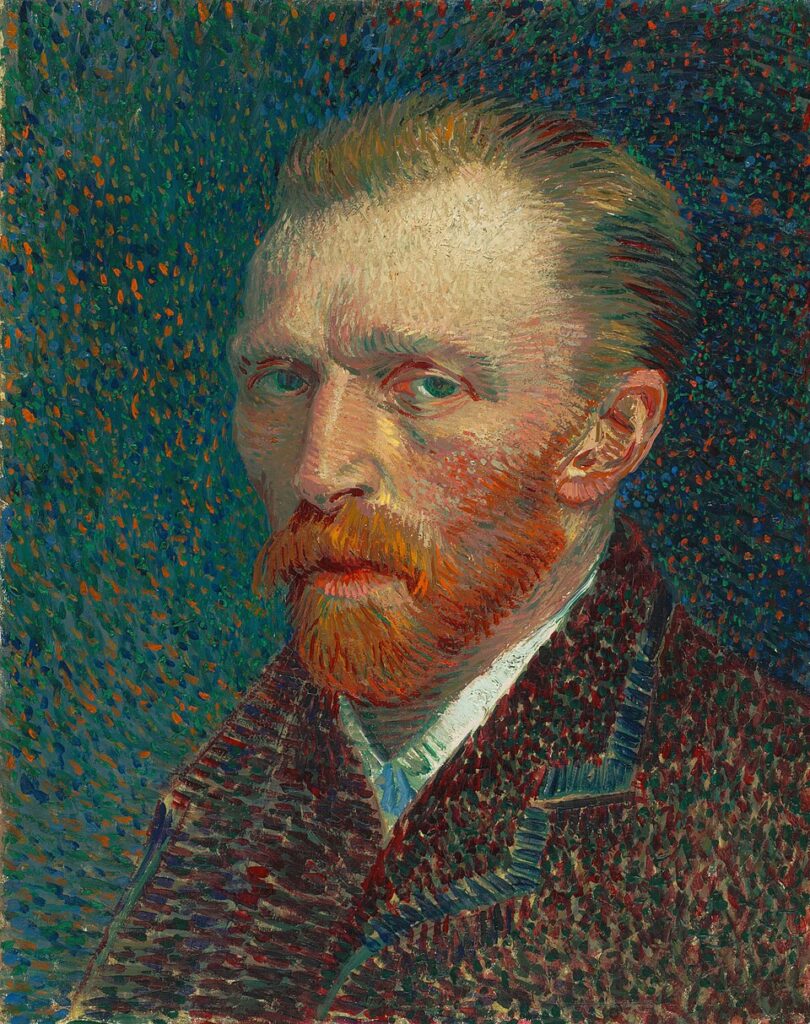
Vincent Willem van Gogh (1853–1890) — the painter — was the oldest surviving child of Theodorus and Anna. The first child born to the couple, also named Vincent Willem, was stillborn exactly one year before the painter’s birth. Growing up with the same name as a dead sibling was a psychological weight several biographers have noted, though Vincent himself left little direct comment on it. He did not begin painting seriously until age 27. He died at 37 in Auvers-sur-Oise, two days after shooting himself in the chest.
Anna Cornelia van Gogh (1855–1930) — the eldest surviving daughter — married a man named Joan van Houten. She had two daughters and lived into her seventies.
Theo van Gogh (1857–1891) — born Theodorus, known as Theo — was the painter’s closest companion and sole financial support for most of his adult life. Theo worked as an art dealer for the firm Goupil & Cie, first in The Hague, then Brussels, then Paris, where he managed a gallery and was deeply knowledgeable about the currents of modern French painting. He and Vincent exchanged over 800 letters across 18 years — more than three-quarters of all letters Vincent wrote went to Theo, including his first and his last. Theo married Johanna Bonger on April 17, 1889. Their son, Vincent Willem, was born January 31, 1890 — a birth that seemed to unsettle the painter, who worried that Theo now had his own family to support. Theo died six months after Vincent, on January 25, 1891, at 33, of dementia paralytica. His remains were eventually moved from Utrecht to Auvers-sur-Oise to rest beside his brother. His wife Johanna requested it: she wanted the brothers to lie together eternally.
Elisabeth Huberta van Gogh (1859–1936) — known as Lies — married a man named Du Quesne van Bruchem and had five children.
Willemina Jacoba van Gogh (1862–1941) — known as Wil — was the youngest sister and the sibling closest to Vincent after Theo. She worked as a nurse, teacher of scripture, and was active in early Dutch feminist circles. She and Vincent corresponded regularly, particularly during his time in Arles and at the asylum in Saint-Rémy. Vincent painted Portrait of the Artist’s Mother and Memory of the Garden at Etten with her and their mother in mind. Wil never married. She spent the last four decades of her life in a psychiatric institution, admitted in 1902 and dying there in 1941 at 79.
Cornelis Vincent van Gogh (1867–1900) — the youngest sibling, known as Cor — was a draughtsman who emigrated to South Africa and fought on the Boer side during the Second Anglo-Boer War. He died at 32 in Brandfort, South Africa, in April 1900 — the third sibling to die young after Vincent and Theo.
Generation Four: Theo’s Son and the Museum
Vincent Willem van Gogh (1890–1978) — named after his uncle the painter — was born in Paris on January 31, 1890, and died in Laren, Netherlands, just three days short of his 88th birthday. He trained as a mechanical engineer at Delft University of Technology, married Josina Wibaut in 1915, and had four children. He became the custodian of the vast collection of his uncle’s paintings and letters that his mother Johanna had assembled and preserved. In 1962, he founded the Van Gogh Museum in Amsterdam — the institution that now holds the largest collection of Vincent’s work in the world, including over 200 paintings and 500 drawings. He lived long enough to see his uncle become perhaps the most recognized painter in history.
Johanna van Gogh-Bonger (1862–1925) — Theo’s wife and the engineer of Vincent’s posthumous fame — was arguably the most consequential person in the history of the artist’s reputation. After Theo’s death left her with an apartment in Paris full of unsold canvases and hundreds of letters, she made it her life’s work to make the world understand what she had. She organized the largest-ever exhibition of van Gogh’s work at the Stedelijk Museum in Amsterdam in 1905. She translated his letters into English. She published the correspondence between the brothers in 1914. She was the reason the letters survived at all — Vincent had not kept Theo’s. She remarried in 1901 to a Dutch writer named Johan Cohen Gosschalk, who died in 1912. She died in 1925 at 62.
Generation Five and Beyond: The Living Line
Theo van Gogh (film director, 1957–2004) — great-grandson of Theo the art dealer, and great-great-nephew of the painter — was a Dutch filmmaker and journalist known for provocative and often controversial work. He was murdered in Amsterdam on November 2, 2004, by Mohammed Bouyeri, a Dutch-Moroccan extremist, following the release of a short film critical of the treatment of women under Islam.
Lieuwe van Gogh (born 1991) — son of the film director Theo van Gogh — is a Dutch painter. He had his first solo exhibition in June 2022. He is the great-great-grandson of Theo the art dealer, and the great-great-great-nephew of the painter. The name has traveled six generations. The painting has come back.
Summary Table
| Person | Relation to Painter | Born | Died | Known For |
|---|---|---|---|---|
| Vincent van Gogh (elder) | Grandfather | 1789 | 1874 | Pastor |
| Theodorus van Gogh (father) | Father | 1822 | 1885 | Pastor, North Brabant |
| Anna Cornelia Carbentus | Mother | 1819 | 1907 | Outlived Vincent by 17 years |
| Vincent van Gogh | The painter | 1853 | 1890 | Post-Impressionist master |
| Theo van Gogh | Brother | 1857 | 1891 | Art dealer, Vincent’s lifelong supporter |
| Wil van Gogh | Sister | 1862 | 1941 | Nurse, feminist, psychiatric patient |
| Cor van Gogh | Brother | 1867 | 1900 | Soldier, died in Anglo-Boer War |
| Johanna van Gogh-Bonger | Sister-in-law | 1862 | 1925 | Built Vincent’s posthumous reputation |
| Vincent Willem van Gogh | Nephew | 1890 | 1978 | Founded the Van Gogh Museum |
| Theo van Gogh (director) | Great-great-nephew | 1957 | 2004 | Filmmaker, murdered in Amsterdam |
| Lieuwe van Gogh | Great×4-nephew | 1991 | — | Painter |