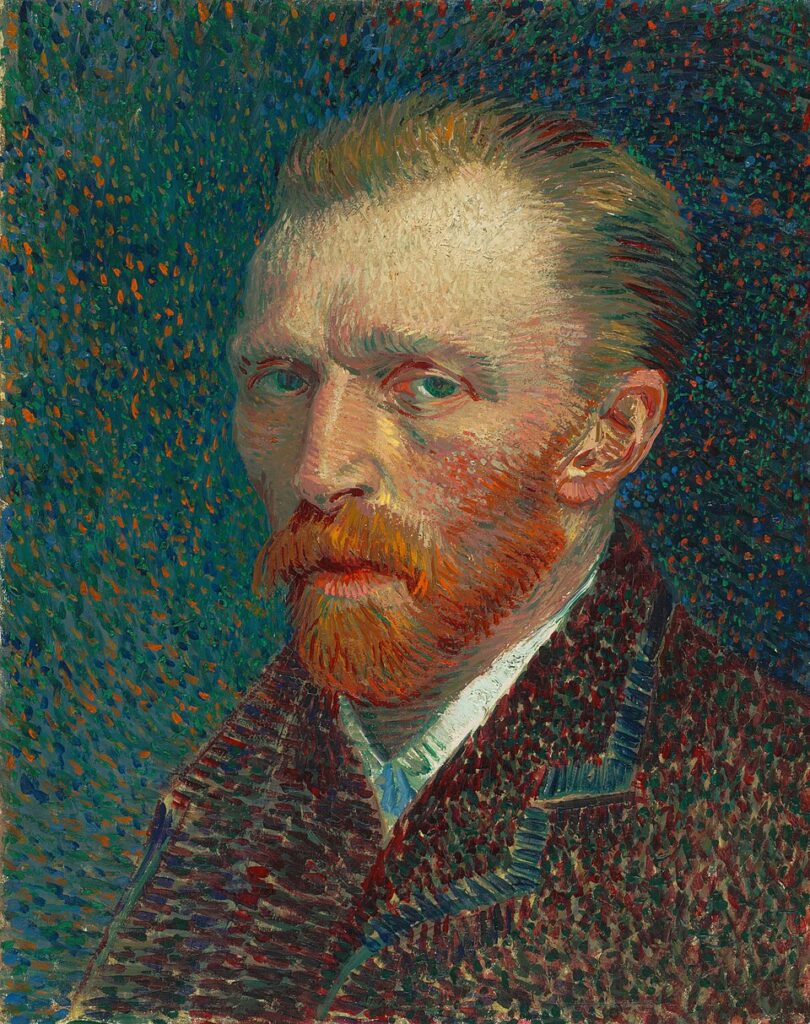
The short answer is yes — but the longer answer is more interesting, and more complicated, than a simple yes. Van Gogh’s relationship with religion was one of the defining dynamics of his life, and it did not follow a clean narrative arc from faith to doubt to abandonment. It transformed, repeatedly, into something that looked less and less like conventional Christianity and more and more like a private theology of labor, nature, and art. He never fully left religion behind. He relocated it.
Where It Started: A Pastor’s Son in a Pastor’s Family
Van Gogh was born in 1853 into a religious household in the Dutch Reformed tradition. His father, Theodorus van Gogh, was the local Protestant minister in Groot-Zundert — a small, close-knit village in North Brabant. His grandfather had also been a pastor. The Dutch Reformed Church, with its Calvinist roots, shaped the rhythms of daily life in communities like Zundert: serious, morally ordered, with a strong emphasis on Scripture and on practical service to the poor.
Van Gogh’s father was described by his contemporaries not as a compelling theologian but as a welfare pastor — someone who distributed food and clothing to those in need, who understood religion as action more than doctrine. That practical emphasis on service to the poor appears to have taken hold in his son more deeply than any formal theology. Long before Vincent could paint competently, the question of what it meant to live among and serve the most vulnerable people was already the central question of his life.
This was not the comfortable, moderate faith of his father’s institutional church. It was something more extreme, and it would cause problems.
The Attempt to Become a Preacher
In his early twenties, Van Gogh pursued religious vocation with an intensity that alarmed people around him. After working in art dealing in London and Paris — work he eventually abandoned in a spiritual crisis — he returned to serious religious study. He moved to Amsterdam in 1877 to prepare for university theology entrance exams, studying Greek and Latin alongside exercises in self-denial that his letters suggest were already becoming ascetic. He failed the entrance exams and did not enter the formal theological program.
Undeterred, he enrolled in a short evangelical training program in Brussels and in 1878 took up a missionary post among coal miners in the Borinage — a bleak industrial region straddling the French-Belgian border, where men and their families lived in grinding poverty, dangerous conditions, and frequent tragedy. Mining explosions were common. Illness was routine. The social conditions were close to Dickensian.
Van Gogh threw himself into this work with a radicalism that went far beyond what his sponsors expected. He gave away his clothing to miners who needed it more. He exchanged his allocated housing for a hovel, sleeping on straw to match the conditions of the people around him. He visited the sick, taught scripture, and worked through mining accidents without flinching. He declared his calling to Theo in a letter from 1876, quoting Isaiah: “He has sent me to preach the Gospel to the poor.”
The evangelical committee that sponsored him was not impressed. An inspector concluded that Van Gogh’s behavior — his poverty, his radicalism, his refusal of clerical distance — bordered on the scandalous. The committee declined to renew his post. He was dismissed as unfit for ministry: too excessive, too strange, too literal in his reading of what serving the poor required.
The dismissal was a wound that marked him permanently. He had tried to live out the Gospel exactly as he understood it — radical, embodied, without the insulation of clerical respectability — and the institution had rejected him for doing so. He did not lose his faith. He lost his faith in the institution.
The Conversion to Art
Van Gogh described his turn to painting explicitly as a “conversion to art.” The language is deliberate. He did not experience it as leaving religion behind. He experienced it as finding a new form for the same impulse.
In a letter to Theo, he wrote: “Painting is a faith.” This is not metaphor used casually. He meant that art carried the same obligations, the same seriousness, the same moral weight that ministry had carried. When he painted peasants, he was continuing the work he had begun in the Borinage — insisting on the dignity and significance of laboring people, on the sacredness of ordinary life. The Potato Eaters (1885), with its dark, heavy figures gathered around a meager meal, is a painting that reads as a kind of Eucharistic meditation — people sharing what little they have, their labor honored rather than aestheticized.
The switch from preaching to painting did not represent a break in Van Gogh’s moral vision. It represented a change in medium.
Still Life with Bible: The Most Theologically Charged Painting He Made
In October 1885, months after his father’s sudden death, Van Gogh painted Still Life with Bible in a single day. It is arguably the most explicitly theological work in his entire output, and one of the strangest and most personal.
The Bible in the painting had belonged to his father — a large, leather-bound Dutch authorized version, open to Isaiah 53. That chapter describes a servant of God as “a man of sorrows and acquainted with grief,” despised and rejected, bearing the suffering of others — a passage that has traditionally been read as a prophecy of Christ, but which maps equally well onto how Van Gogh appears to have understood his own failed ministry and his ongoing life among the poor.
In front of the Bible, small and luminous against the dark background, sits a copy of Émile Zola’s novel La Joie de Vivre — a book Van Gogh admired enormously. The juxtaposition has been read by most commentators as a statement of opposition: the old faith against secular modernity, the father against the son. A snuffed candle stands beside the Bible — usually interpreted as marking his father’s death.
But this reading may be too clean. Kathleen Powers Erickson, in her book At Eternity’s Gate: The Spiritual Vision of Vincent van Gogh, argues that Van Gogh saw Isaiah 53 and Zola’s novel as speaking the same truth by different means — both concerned with sorrow, service, and what it means to live for others rather than for oneself. Rather than old religion versus modern literature, Van Gogh may have been showing that his new bible and his father’s bible were not as opposed as they appeared. The man who had given away his clothes to miners and the man who admired Zola’s working-class naturalism were the same person.
What He Lost and What He Kept
What Van Gogh definitively left behind was institutional Christianity. After the Borinage, he stopped attending church, stopped participating in formal religious community, and developed increasingly critical views of organized religion — the “cold theologians,” as he called them in a letter, who had replaced genuine faith with doctrinal propriety. He found the institutions that bore the Christian name incompatible with what he believed Christianity actually required.
What he kept is harder to categorize but clearly present in his letters. He maintained a reverence for Christ as a figure — not the Christ of doctrine or of the institutional church, but the Christ of the Sermon on the Mount, the Christ who blessed the poor in spirit, who healed the sick, who sat with prostitutes and tax collectors. He described Christ to his friend Émile Bernard as “the greatest of all artists.” This is not the language of someone who had abandoned religious feeling. It is the language of someone who had relocated it.
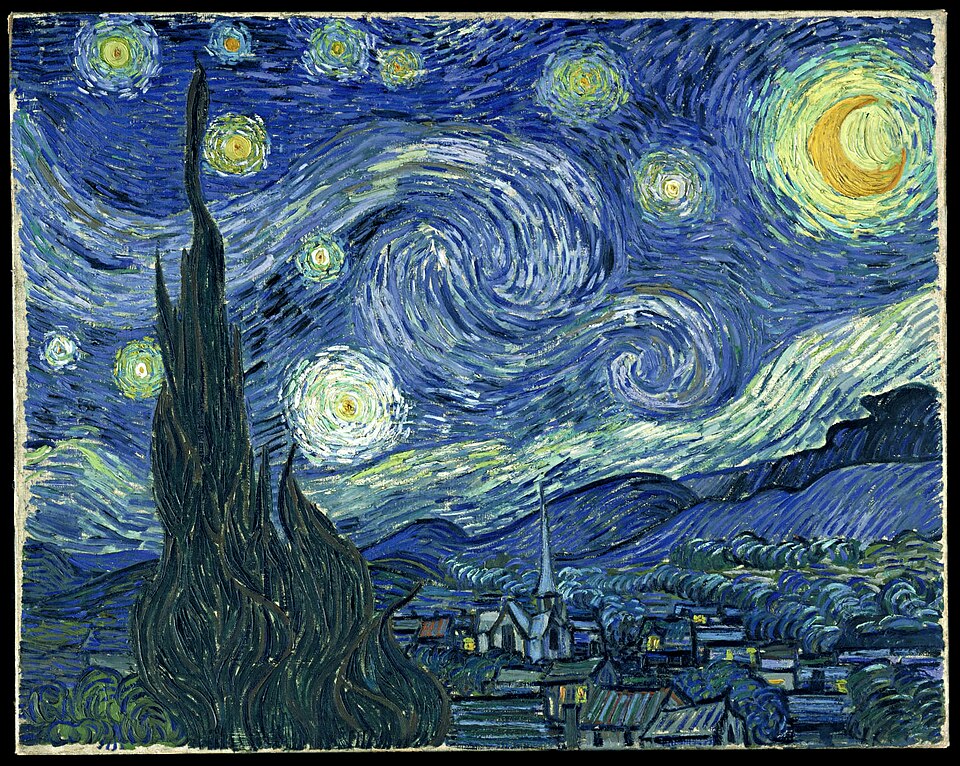
He also kept a genuine preoccupation with mortality, transcendence, and what comes after death — subjects he approached through painting rather than through theology. Stars, in particular, became a recurring site of spiritual attention. In September 1888 he wrote to Theo: “When I have a terrible need of — shall I say the word — religion, then I go out at night to paint the stars.” The formulation is careful: he hesitates over the word “religion” as though uncertain whether it still belongs to him, but then uses it anyway. Painting the night sky was, for him, what prayer had once been. Not a rejection of the sacred but an alternative way of approaching it.
The Starry Night as Spiritual Document
The Starry Night (1889) was painted while Van Gogh was a voluntary patient at the asylum in Saint-Rémy. The village in the painting is largely invented — not visible from his window. The church in the village is dark, its windows unlit, while the surrounding houses glow warmly. This detail is usually read as a statement about institutional religion: the church is present in the community but its light is out, while ordinary life continues to illuminate the world.
The swirling sky above is something else entirely. Scholars have noted that the turbulent whorls of the sky correspond to natural patterns of fluid turbulence that physics would not formally describe for decades. Whether or not Van Gogh perceived this consciously, the effect is of a cosmos that is alive and in motion — not dead matter but something animated, energetic, present. Several art historians have suggested that Hokusai’s Great Wave may have influenced the sky’s movement, but the spiritual content is Van Gogh’s own.
He wrote to his brother while making works in this series that he was trying to express through the stars something about life after death — his recurring preoccupation. He was not a conventional believer in resurrection or in any specific doctrinal account of what follows death. But he believed that something continued, that the energy of a human life did not simply terminate, and that painting stars at night was a way of reaching toward that belief.
The Van Gogh Museum’s Answer and Why It’s Correct but Incomplete
The Van Gogh Museum in Amsterdam states it plainly: “Van Gogh was certainly religious, although his beliefs did change with time.” The museum notes that he ultimately came to see nature and human history as jointly symbolizing God — a pantheistic or panentheistic orientation rather than orthodox Christianity, but religious nonetheless.
This is accurate as far as it goes. What it may understate is the degree to which Van Gogh’s later spirituality was not simply a retreat into nature-worship but a sustained attempt to hold together what he had learned in the Borinage — that religion must express itself through service and solidarity with the suffering — with what he had found in painting: that beauty, honestly pursued, is itself a moral act.
The two impulses were not in tension. They were the same impulse in different clothes.
The Question of Whether Art Replaced Religion or Became It
The conventional narrative divides Van Gogh’s life into a religious phase and an artistic phase, with the Borinage dismissal as the turning point. This is a misleading simplification.
Erickson’s study of his letters found that religious faith permeated his entire life and vision continuously — that his artistic work was an extension of his earlier religious life, not an abrupt discontinuity. The subjects changed. The moral seriousness did not. The institutional framework was stripped away. The underlying orientation toward the sacred remained.
In his letters Van Gogh makes over 800 references to books and articles, across French, Dutch, and English literature — Dickens, Zola, George Eliot, Harriet Beecher Stowe — and many of these references are about what literature does that religion, in its institutional form, often fails to do: it shows human suffering honestly, without prettifying it, and in doing so insists on its significance. He found in great novels the same thing he had found in Isaiah 53 and in the Sermon on the Mount: the claim that ordinary suffering matters, that the poor in spirit are blessed, that a man of sorrows can be a servant of God.
He painted that claim, in fields and faces and night skies, for the last decade of his life.
Conclusion
Was Van Gogh religious? Yes — persistently, painfully, and in ways that the institutional church he came from was not equipped to contain. He began as a pastor’s son who wanted to become a pastor, failed at that on the institution’s terms, lived out his vocation by other means, and never fully recovered from or fully abandoned the faith that had shaped him. He moved from a Christianity of doctrine and church membership to something harder to name: a conviction that beauty and honest attention to suffering were forms of devotion, that painting stars at night was a kind of prayer, and that Christ — stripped of theology — was the greatest artist who ever lived.
The religion did not disappear. It went underground, became structural, and surfaced in everything he made.