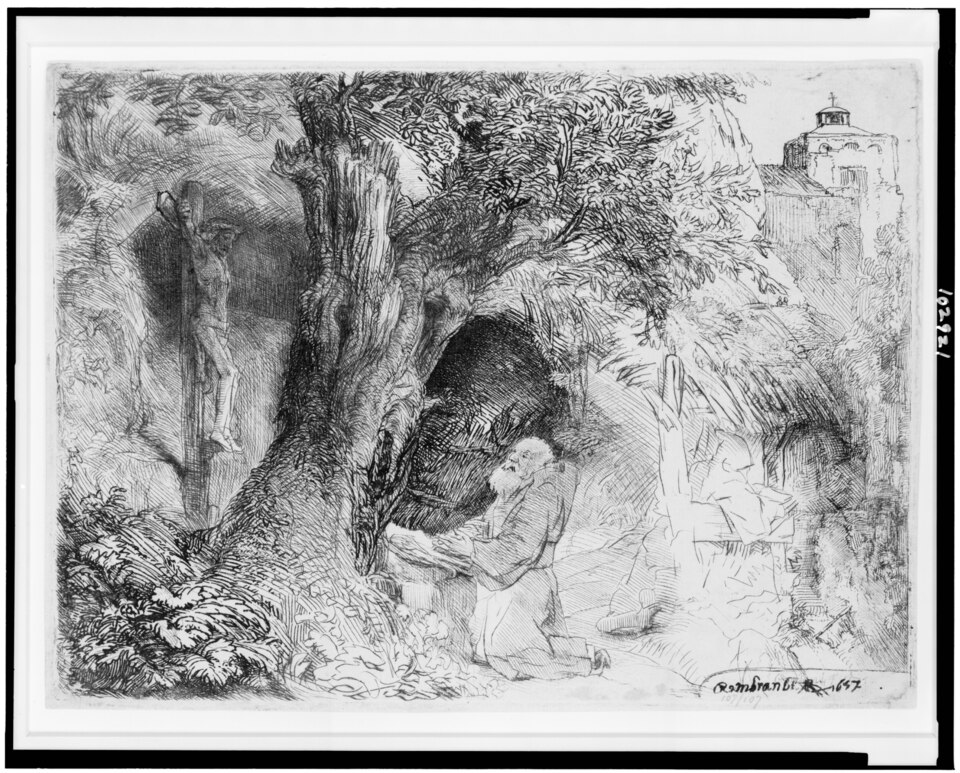
When people think of Rembrandt van Rijn, they think of paintings — of The Night Watch, The Anatomy Lesson, the self-portraits gathered in dim light, the faces of Amsterdam’s wealthy merchants rendered with uncanny psychological precision. What they rarely think of first is his printmaking. This is an almost complete inversion of how Rembrandt was understood during his own lifetime.
During the 17th century, Rembrandt’s etchings traveled across Europe in ways his paintings never could. They were collected in Amsterdam, Paris, London, and Rome. Collectors competed for different impressions of the same plate. His painted work was largely local; his printed work was what made him internationally famous. The etchings are not a footnote to the paintings. For a significant part of his career, they were the primary medium through which he explored his ideas — and in several instances, they represent the most technically audacious work he ever made.
What Intaglio Is and How It Works
Intaglio is a family of printmaking techniques defined by a single principle: ink is held in recessed lines or pits cut into a plate, and the image is transferred to paper by pressing the paper against the inked plate under high pressure. The word comes from the Italian intagliare, to cut. Where relief printing (like woodblock) transfers ink from raised surfaces, intaglio transfers it from incised ones.
In Rembrandt’s day, three intaglio techniques were in use, and he eventually worked in all three.
Engraving is the oldest and most demanding. A burin — a small, hardened steel tool — is pushed across the metal plate to cut V-shaped channels directly into the surface. The technique requires exceptional physical control, strength, and precision. Lines made by engraving have clean, sharp edges and a characteristic swelling and tapering as the burin is pressed and released. Rembrandt used pure engraving sparingly; its demands conflicted with his preference for spontaneity.
Etching is a chemical process, and it suited Rembrandt’s working method far better. The metal plate — usually copper — is first coated with a ground: a protective layer of wax or resin. The artist draws through the ground with a metal needle, exposing the copper beneath. The plate is then immersed in an acid bath. The acid attacks only the exposed metal, biting grooves into the surface wherever the needle has drawn. The depth of the groove — and therefore the darkness of the printed line — is controlled by the duration of the acid bite: lines that need to be lighter are stopped out with varnish before the plate goes back in the acid for further biting. After the acid work is complete, the ground is removed, the plate is inked, the surface is wiped so that ink remains only in the grooves, and damp paper is pressed against it under a roller press, pulling the ink out of the lines.
The crucial advantage of etching over engraving is that the needle moves through soft wax rather than hard metal. The hand can work freely, with the same ease and speed as a pen or pencil on paper. Rembrandt grasped this immediately, and the spontaneity it permitted transformed his approach to drawing on the plate.
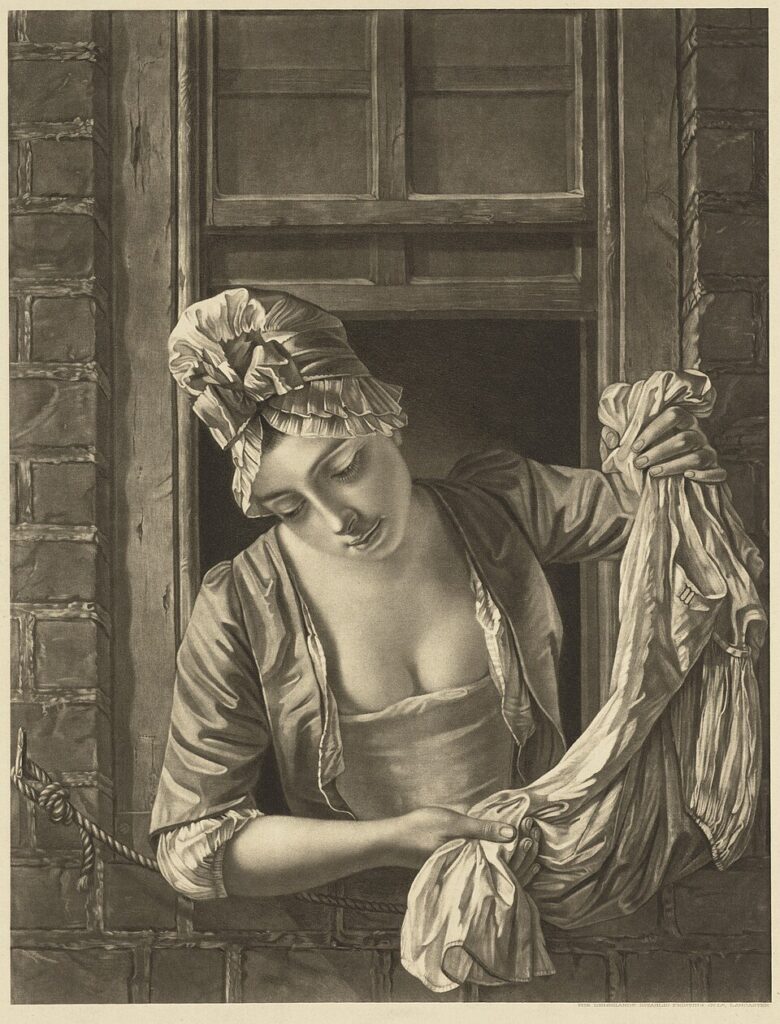
Drypoint is the simplest technique of the three and the one that most directly corresponds to drawing. A sharp needle or stylus is dragged across the bare metal plate without any acid or ground. The needle scores the surface and throws up a ridge of displaced metal on either side of the line — the burr. Unlike engraving, where burr is scraped away to produce clean edges, in drypoint the burr is left intact. When ink is applied and the plate is wiped, the burr holds a dense film of ink that prints as a soft, rich, velvety black — qualitatively different from any line produced by acid or burin.
The limitation of drypoint is physical: the burr is fragile. Each time the plate passes through the press, the pressure slightly crushes the burr, and its capacity to hold ink diminishes. A drypoint plate in its finest condition might yield ten or twenty impressions before the velvety quality of the lines begins to degrade. After fifty or sixty impressions, the burr may be effectively gone.
Rembrandt’s Mastery and Innovation
Rembrandt was not the inventor of any of these techniques. Engraving predated him by two centuries. Etching had been practiced by Albrecht Dürer and others since the early 16th century. Drypoint had been used occasionally before him. What Rembrandt did was push all three — and especially their combination — to a level of sophistication and expressive power that no one before him had approached.
His early etchings, made in the late 1620s and 1630s, show him learning the medium rapidly. He worked in pure etching initially, exploring how acid-bitten lines could build up tonal depth, how leaving areas of the plate unworked could suggest light, how the needle could capture the texture of cloth, skin, and shadow. His first plates were exercises; within a few years they were major works.
From around 1640, he became increasingly drawn to drypoint, both as a standalone technique and as a supplement to etching. He began adding drypoint passages to etched plates — using the velvety burr to enrich shadows, deepen flesh tones, and create tonal transitions that acid alone could not achieve. The combination gave him an unprecedented range: from the most delicate, lightly bitten lines at one end of the tonal scale to the deepest, most saturated blacks at the other.
He also made a technical discovery that extended the working life of drypoint plates: Japanese paper. The smooth, fibrous texture of imported Japanese paper was gentler on the fragile burr than the rougher European papers of the time, meaning that fine impressions — with the burr fully intact — could be pulled from more copies before the distinctive quality began to fade. Rembrandt found that, due to the smooth texture of Japanese paper, the drypoint elements of his prints were more distinguishable and did not wear away as quickly. Collectors knew this, and impressions on Japanese paper were prized and priced accordingly.
States: The Creative Process Made Visible
One of the most distinctive features of Rembrandt’s printmaking is his use of states. A state is a distinct version of a print taken from a plate at a particular moment in its development. When an artist reworks a plate — adding lines, removing areas with a burnisher, deepening shadows, altering figures — and then pulls new impressions, those impressions represent a new state. All prints from before the reworking are an earlier state; all prints from after are a later one.
Most printmakers produced a small number of states. Rembrandt treated the state system as a creative method in itself, sometimes producing ten or more distinct states from a single plate, occasionally reworking a composition so radically between states that the result was effectively a new work.
It is not uncommon to find as many as four or five different states of the same etching; sometimes the changes are minor, and sometimes radical. Almost from the start of his career, Dutch collectors were eager to purchase the variations. The demand was so well established that a 17th-century biographer noted sarcastically that a collector was “not considered a true amateur” unless they possessed specific etchings in multiple states — the Juno with and without the crown, certain portraits with light and dark heads.
This collecting behavior was not mere connoisseurship for its own sake. Rembrandt was genuinely using the states as a workshop — returning to plates over months or years, reconsidering them, testing different solutions to compositional or tonal problems. The states give us access to his thinking in a way the paintings, which are finished single objects, cannot.
The Masterpieces: The Hundred Guilder Print and The Three Crosses
Two works stand above the rest as evidence of what Rembrandt could achieve in intaglio at the peak of his powers.
The Hundred Guilder Print (c. 1647–1649) — formally titled Christ Healing the Sick — takes its popular name from the extraordinary price it commanded even during Rembrandt’s lifetime, when most prints sold for fractions of a guilder. It was widely hailed as his best, a large-format etching with some drypoint that represented Christ’s ministry of preaching and healing the sick, combining several scenes from the nineteenth chapter of Matthew’s gospel into a single image of extraordinary tonal range. The left side of the print is rendered in the most delicate, barely bitten lines; the right side plunges into deep, richly inked shadow. The two ends of the tonal scale coexist in the same image, held together by the central figure of Christ — lit from within, it seems, rather than by any identifiable external source.
It is also a technically complex hybrid: etching, engraving, and drypoint are all present in the same plate, each contributing to specific areas of the image. Scholars describe it as a “technical tour de force, incorporating an enormous diversity of printmaking styles and techniques.” It survives in only two states, but the differences between individual impressions — from the paper used, the inking, the wiping — mean that no two copies are quite alike.
The Three Crosses (1653) is the more radical work. Made almost entirely in drypoint, it depicts the crucifixion of Christ with a monumentality and darkness unprecedented in printmaking. It is considered “one of the most dynamic prints ever made.” The plate exists in four states, and between the third and fourth states Rembrandt undertook a reworking so severe that the composition was essentially reimagined. In the early states, light falls across the scene as a kind of divine illumination; the figures are legible, the drama terrible but comprehensible. In the fourth state, Rembrandt reworked the plate with dense, broad strokes of drypoint — long, dark, closely-laid grooves that drove the image into near-total darkness. Figures that had been clearly present disappear into shadow. The Virgin Mary becomes almost a disembodied head. The tone shifts from narrative drama to something approaching apocalypse.
Rembrandt was the first artist to fully exploit the dark velvety richness and painterly effects of drypoint, created by the inked burr, or metal residue, left by the fine lines scratched directly into the copperplate with a needle. In The Three Crosses, that exploitation reached its extreme point.
The Self-Portrait Etchings
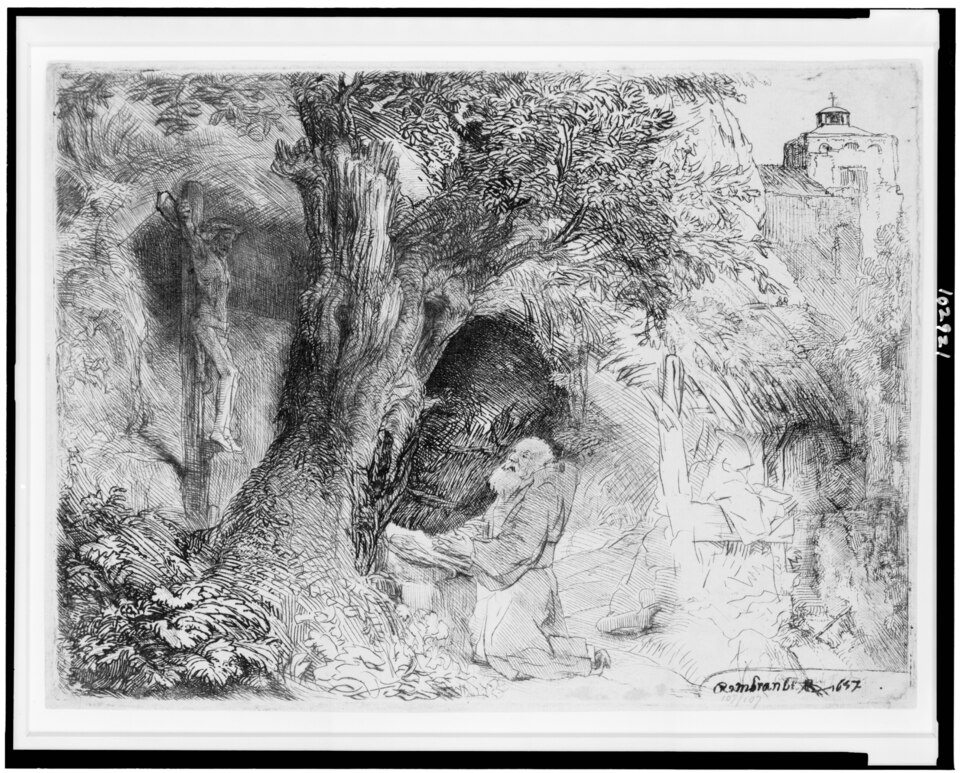
Rembrandt etched approximately 30 self-portraits, ranging from small, rapid character studies — himself grimacing, shouting, staring wide-eyed, wearing elaborate hats — to the more considered, finished compositions that parallel his painted self-portraits. The etched self-portraits served partly as demonstrations of emotional range: a kind of actor’s exercise in which Rembrandt used his own face as a model for testing how printed lines could capture transient expression. They are also among the earliest and most concentrated examples of an artist using the print medium for sustained psychological self-examination.
Several of the etched self-portraits show what the medium could do that paint could not: the rapid, sketchy quality of some — barely a few dozen lines describing a face — demonstrates intaglio’s capacity for spontaneity at a scale that oil on panel simply does not permit.
Reputation During His Lifetime — and After
Unlike his paintings, his prints circulated throughout Europe during his lifetime, contributing to his great reputation. Eighty of his original copper plates survive, and for two centuries after his death they passed through collectors’ hands, being reworked and printed from repeatedly — a practice that produced impressions of varying quality but kept his work in circulation. In 1993, a collection of plates was sold at auction and dispersed globally; several returned to Dutch institutions including the Rembrandthuis and the Rijksmuseum.
The Rembrandthuis in Amsterdam — the house he lived in during his most commercially successful years — has a printing press reconstructed in the original room where Rembrandt is believed to have worked. It is one of the more concrete connections available to anyone trying to understand how he actually made these objects: the press, the plates, the acid bath, the paper. The etchings were not a sideline. They were where Rembrandt spent a significant portion of his working life, and where he found solutions to problems — about light, about shadow, about how to render a human face at the edge of darkness — that fed back into his painting and influenced every printmaker who came after him.
What the Etchings Tell Us That the Paintings Don’t
Rembrandt’s paintings are, by their nature, finished objects — the end result of a process that is largely hidden. The states of his etchings expose the process. They show him changing his mind, pushing compositions further, abandoning solutions and trying others, returning to work he had set aside. They reveal the thinking behind the seeing.
They also show a willingness to accept limitation as a creative condition. The burr wears away. The acid bites unpredictably. The paper matters. Each impression is slightly different from the last. Rembrandt worked with these constraints rather than against them, finding in the particular qualities of each technique — the softness of drypoint burr, the spontaneous line of the etching needle, the deep blacks that only drypoint can produce — the specific visual effects he was after.
He was, as the Metropolitan Museum’s research has put it, “the first artist to fully exploit the potential of drypoint.” That the rest of the Western world is still catching up to what he did with a needle, a copper plate, and a press in 17th-century Amsterdam is a fact that the paintings alone cannot fully explain.
Return to Home page on here